


Flexible Lock Optimization Self Retracting Lifeline, Overhead, Class 1, 50ft
Overhead SRDs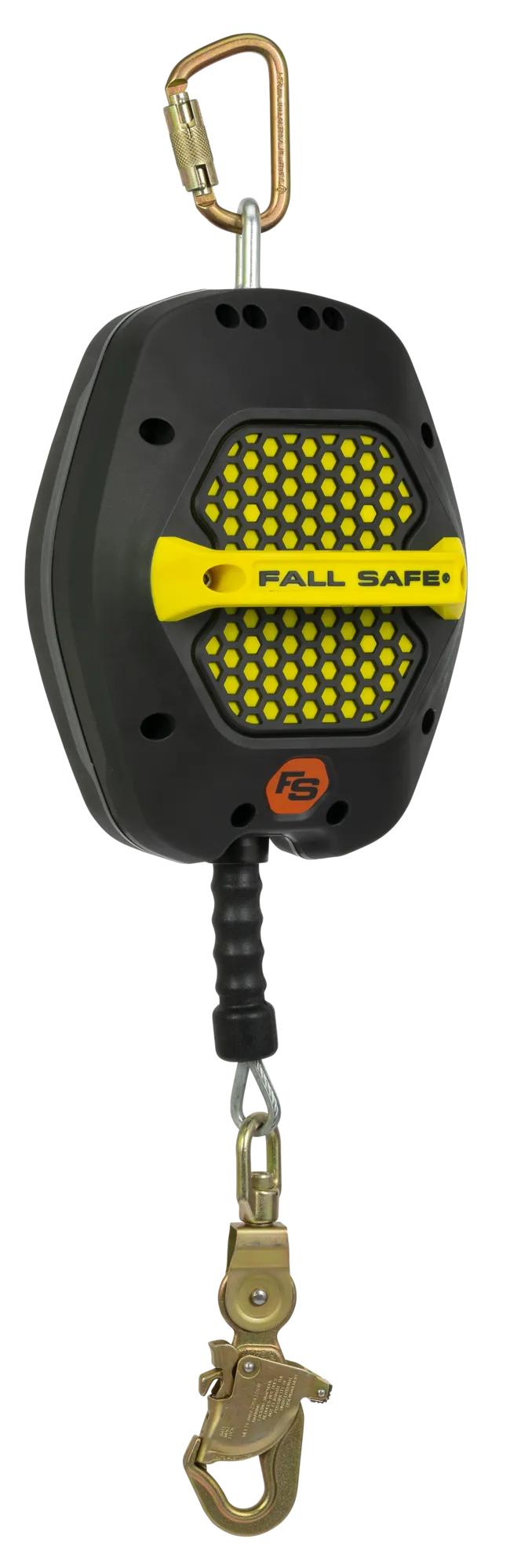
The F.L.O™ SRL is revolutionizing fall protection with industry first technology that works with you—not against you. Powered by dual motion detection—velocity and acceleration— it knows when to move and when to react. The result: smooth performance, real protection, and no more false stops.
- No trade offs between useability and fall clearance, F.L.O.™ is smart enough to know the difference between a fall and fast-paced work
- Proprietary and patented Dual-Sense Motion technology, reduces nuisance lock ups
- Senses both velocity and acceleration to tell the difference between a real fall and regular movement
- Ergonomically designed handle allows for easy lifting when used in overhead applications
- Rolling-friendly housing protects labels and is built with durable impact resistant materials
- F.L.O.™ has a max arresting distance of only 22 inches and a maximum arresting force of only 900 lbf.
- Swiveling connectors eliminates cable twist
Available Variations & Documents
- Standards
- ANSI Z359.14-2021 Class 1, OSHA
- Class Type
- Class 1
- Color
- Black/Yellow
- Leading Edge
- No
- Rescue and Recover - SRL-R
- No
- Capacity (lb.)
- 310
- Capacity (kg.)
- 140
- Minimum Fall Clearance - Non-Leading Edge application (ft.)
- 4
- Minimum Fall Clearance - Non-Leading Edge application (m)
- 1.2
- Maximum Total Arrest Distance - Non-Leading Edge application (in.)
- 24
- Maximum Total Arrest Distance (m)
- 0.55
- Average Arrest Force
- 650
- Housing Material
- Reinforced Nylon
- Anchor Hook Material
- Steel
- Lifeline Material
- Galvanized Steel
- Body Hook Type
- Carabiner
- Anchor Hook Type
- Snap Hook
- Webbing/Cable Thickness (in.)
- 0.18
- Webbing/Cable Thickness (mm.)
- 4.75
- Length (m.)
- 15.2
- Length (ft.)
- 50
- Gate Opening (in.)
- 1
- Gate Opening (mm.)
- 25.4
Frequently Asked Questions
No, Fall Safe doesn't recommend it. With a D-ring extender, the SRL's energy absorber sits away from the worker's back, where it can strike the edge in a fall and may cause the lifeline to separate. Connect leading-edge SRLs directly to the dorsal D-ring as shown in the user instructions. See the Fall Safe technical bulletin on D-ring extenders for details.
Yes, but only an ANSI Z359.14 Class 2 personal SRL. Class 1 SRLs aren't approved for use in a MEWP, because they're designed for anchorage at or above the dorsal D-ring. When the MEWP is traveling or being repositioned, Fall Safe recommends a restraint lanyard, such as part 717505, instead.
Yes. Fall Safe SRLs are tested to ANSI Z359.14 requirements, which cover performance at temperatures from -40°F to 130°F. In freezing conditions, check the lifeline and housing for ice before each use, since ice can affect retraction and locking.
The Micro-Loc and Skyloc II ANSI Z359.14 Class 1 models are rated for a maximum capacity of 400 lb, including the worker's clothing, tools and equipment. Most fall protection equipment is rated for 130 to 310 lb, so check that every part of the system, including the harness, anchorage connector and anchorage, is also rated for the heavier load.
It depends on where the device is anchored and how far the worker moves from it. As a guide, Fall Safe Class 2 leading-edge devices need as little as 4 ft of clearance when anchored overhead, about 11 ft when anchored at foot level with no swing, and up to about 20 ft when the worker is offset to the side and a swing fall is possible. Calculate clearance before starting work, set up the anchorage to minimize swing falls, and use the clearance chart in each product's user instructions.
The Skyloc II is a self-retracting lifeline for fall arrest when working at height. It's lightweight and portable, so it's easy to move between jobs and work areas. A leading-edge version (Skyloc II LE) is available for work near unprotected edges.
The Skyloc II is used in construction, maintenance and other industries where workers need fall arrest at height. The leading-edge version (Skyloc II LE) is designed for work near unprotected edges. Check each model's ANSI class before use: Class 1 for anchorage at or above the dorsal D-ring, Class 2 for leading edges and anchorage below it.
Skyloc II Class 2 models use a 7/32 in galvanized steel cable lifeline, and Class 1 models use 3/16 in galvanized steel cable. Some configurations, such as the Wildcat, use stainless steel cable or Dyneema rope instead. Check each model's specifications for its lifeline type.
The FT-R's swiveling anchor and leg-end connectors make the device easier to install and keep the lifeline from twisting as the worker moves.
The Skyloc II meets OSHA 29 CFR 1926.502 (construction) and 1910.140 (general industry) and ANSI/ASSP Z359.14-2021. See each model's label and Declaration of Conformity for its ANSI class.
Unsure what gear is right for your needs?
Our experienced team of Fall Safety experts can help.